From fieldwork to lasting business capability.FORWARD-DEPLOYED ENGINEERING
Agent Cases
← All casesFIELD NOTE 06 / Product & Experience

Nora—

From “try saying it, then tap to listen”
to a prototype with text, images and audio on both platforms.

Prototype builds packaged for both mobile platforms

A bilingual guessing product for young children aims to let them try naming an object in a picture before choosing to tap and hear its pronunciation. Cards, clues, Chinese and English audio, taps and swipes all need to work together. With product and experience reviews guiding the work, Nora turned this principle into a working guessing loop, added coordinated content and an exploration sequence, and packaged mobile builds for subsequent playtesting.
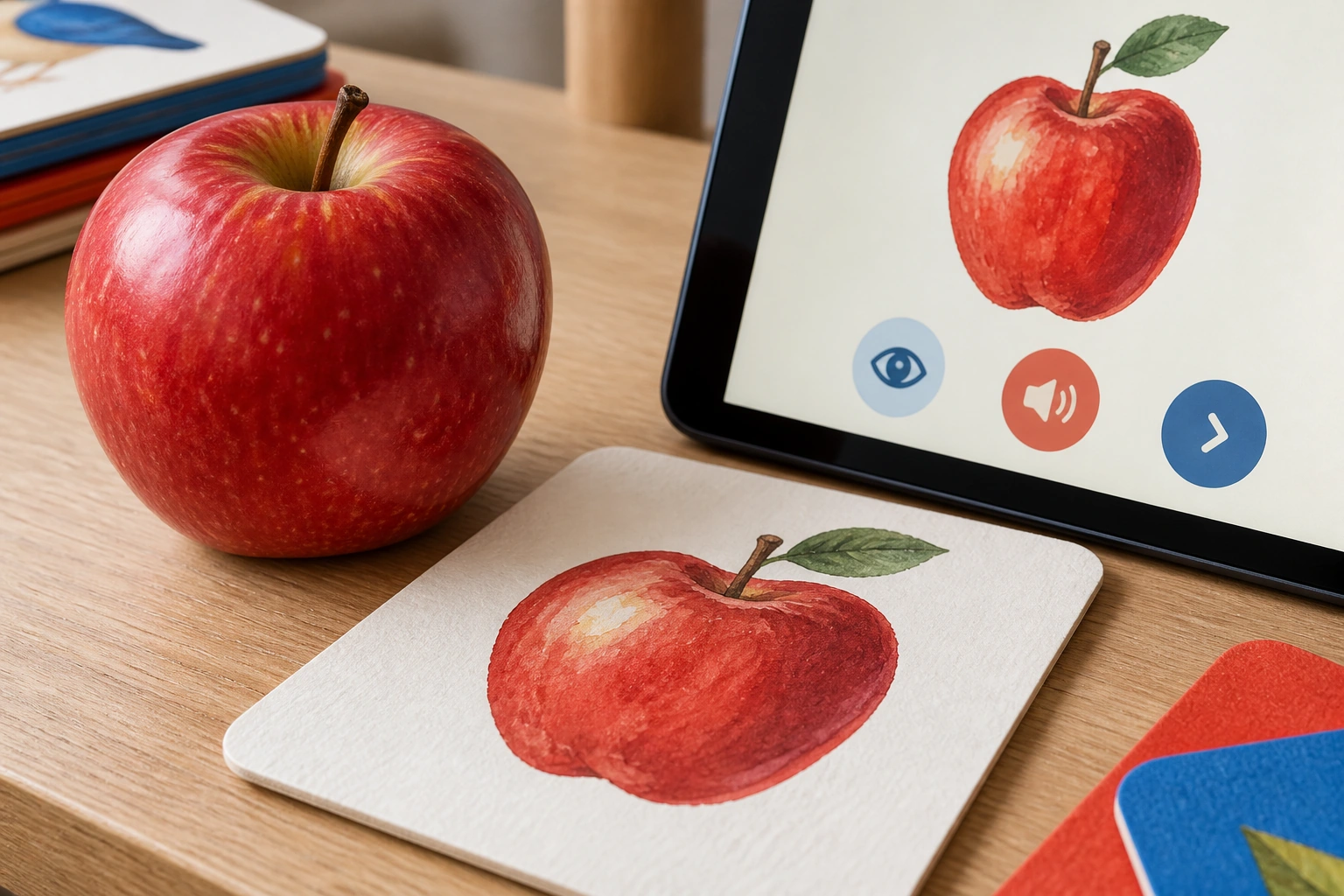
A red apple, a hand-drawn apple card and the same illustration on a tablet show the transition from an asset to an interactive product
Taking an illustration into an interactive product means designing images, words, audio and actions together.
A Chinese–English guessing experience for young childrenInteractions, clues, images and audio delivered togetherBoth mobile builds packaged; family playtesting still to come

WHY THIS WORK MATTERS

How can a product principle become cards, clues, bilingual pronunciation and an exploration sequence, delivered as a mobile prototype for further playtesting?

BUSINESS VALUE

Ground product discussions in specific interactions and complete content. The team can check whether the experience reflects its original goal and has a production process that can be extended and handed over, preparing the product for real playtesting.

  1. 01Define how a guessing round starts and ends
  2. 02Build looking, guessing and tap-to-listen actions
  3. 03Refine clues and the bilingual playback order
  4. 04Plan a sequence for new cards and review
  5. 05Check that cards, images and audio match
  6. 06Package both mobile builds and playtest tasks

WHAT THE TEAM BRINGS

The target age and core product principle, a set of objects and bilingual names, understandable feature clues, visual and voice requirements, and the intended mobile playtesting context.

WHAT THE WORK LEAVES BEHIND

  • A bilingual guessing prototype with a continuous play loop
  • Matching cards, clues, images and audio
  • Production and checking scripts for expanding the content
  • Both mobile builds and handover notes for later playtesting

HOW TO ASSESS A PILOT

  • Completion of a guessing round and interaction errors during playtests
  • Mismatched or missing text, images and audio in content samples
  • Consistency of playback and card switching across both platforms
Suggested evaluation criteria—not measured results claimed for this case.
START SMALL

Use a small card set to build a complete guessing loop. Check whether swipes, prompts and tap-triggered audio reflect “try first, then listen.” After the necessary preparations, test with real families before deciding how to expand the content. Evaluate learning effectiveness separately.

See the actual process

THE METHOD IN A WORKING EXAMPLE

One action, one meaning. The same principle on every screen.

Nora’s product work includes defining what each child’s action means and keeping content, audio and layouts across devices consistent with those principles.

FIGURE 01Case illustration · English board

Guess, reveal a clue, choose to listen, move on: design each action separately.

A card board redesigned around the interaction principles in this case, not a screenshot of the original app.

What to look for

Clues, audio and moving to the next card respond to separate user intentions. The right explains why these three actions should stay distinct. The mobile implementation must follow the same principles.

The work in this case

Nora separates switching cards from playback while handling clue content, batch audio production and resumable work. An installation package marks a delivery stage; learning outcomes still require separate validation.

01 / THE ASSIGNMENT

Start where the business
gets stuck.

An educational content team wants to create a bilingual guessing product for young children, based on trying to say the answer before choosing to listen. Testing the idea requires content, interaction and audio to support one complete, continuous round.

01

The goal is to let children speak first, but the interface may reveal the answer early

Playing audio automatically after a swipe merges trying and confirming. The product principle must determine when cards change and when audio plays before it can be observed in later playtests.

02

Children need to understand the clue and what to do next

Small buttons are hard to discover, broad clues are hard to guess from, and complex menus interrupt exploration. Images, prompts, tap areas and feedback need to support a simple round together.

03

More cards still need variety and a manageable sequence

Pure randomness can cluster similar content and make it difficult to balance new cards with review. The selection sequence needs to support continued exploration while keeping the interface understandable.

04

One playable card is not yet a deliverable content set

Each image must match an object, its bilingual name and clue audio. Interrupted generation or mismatched assets causes repeated work when content is expanded and builds are packaged.

02 / THE CONTINUOUS WORK

Each deliverable must help
the next task move forward.

Expand each stage to see its inputs, decisions, actions, outputs and handoff. Each step explains how the next person could continue.

  1. 01First build one complete guessing round
  2. 02Let children choose when to hear the pronunciation
  3. 03Make clues specific and distinguish what interaction records mean
  4. 04Give the next card variety while allowing for review
  5. 05Expand a playable card into coordinated text, image and audio content
  6. 06Deliver mobile prototypes that can be tested and refined
01

First build one complete guessing round

A guessing loop that can be used continuously.

Input
A product goal in which young children look at an object, try naming it and hear bilingual pronunciation.
Decision
First define how children start, ask for help, hear the answer and move on, so the team can check whether the principle is present in the experience.
Action
Built a card connecting an object image, bilingual names and clues, with the core flow of trying to speak, tapping to hear audio and swiping for clues or another card.
Output
A guessing loop that can be used continuously.
Handoff
Visual work, audio and content expansion all build on the same interaction loop.
02

Let children choose when to hear the pronunciation

Clearer interaction cues and a predictable bilingual sequence.

Input
The first card design, small-button interactions and product experience review feedback.
Decision
A swipe only needs to change the card state. A deliberate tap should trigger pronunciation, and the main tap target must be easy to find and reach.
Action
Expanded the object and card tap areas, added a speaker cue and press feedback, removed automatic audio after swiping, and fixed the playback order as English, English, Chinese, Chinese, English.
Output
Clearer interaction cues and a predictable bilingual sequence.
Handoff
Later playtests can observe whether users understand switching and playback, rather than evaluating appearance alone.
03

Make clues specific and distinguish what interaction records mean

More specific prompts and clearer interaction events.

Input
Card clues, recommendation logic, and experience and educational review feedback.
Decision
Opening a clue may express curiosity or a need for help. Tapping to confirm also provides only a limited behavioral signal.
Action
Replaced broad clues with concrete settings such as the sky, water or tracks, and separated records and uses for viewing clues and confirming answers.
Output
More specific prompts and clearer interaction events.
Handoff
Recommendations can use these limited signals to arrange content. Whether a child has learned it still needs separate validation.
04

Give the next card variety while allowing for review

Content selection logic that considers both exploration and review.

Input
Cards covering animals, fruit and vegetables, transport, toys and nature, together with recent interaction information.
Decision
Unconstrained randomness can cluster content, while a fixed sequence reduces the sense of discovery. Children do not need to manage these selection conditions themselves.
Action
Filtered candidates using recent appearances, new content, review needs and category diversity, then selected among them with weighted randomness.
Output
Content selection logic that considers both exploration and review.
Handoff
The child-facing interface remains a simple card stream while the team can adjust the selection rules and observe the experience.
05

Expand a playable card into coordinated text, image and audio content

Coordinated cards, clues, images and audio, plus resumable production scripts.

Input
Object and clue lists, voice requirements and image generation tasks.
Decision
Batch production must keep names, images and audio aligned and allow work to continue after a timeout.
Action
Organized image and audio generation, normalization and size checks; added retries and resume points; and checked the resource list item by item.
Output
Coordinated cards, clues, images and audio, plus resumable production scripts.
Handoff
The content team or a future owner can fill gaps and expand the assets while retaining completed work.
06

Deliver mobile prototypes that can be tested and refined

Packaged mobile prototypes and handover materials.

Input
The working guessing experience, asset list and mobile delivery requirements.
Decision
Packaging establishes that the prototype can be handed over. Real family use, privacy preparations and store review are still subsequent work.
Action
Packaged both mobile builds, documented build, checking and handover procedures, and listed playtesting and prerelease tasks.
Output
Packaged mobile prototypes and handover materials.
Handoff
The next phase uses real usage feedback to evaluate interactions and content, with a separate design for assessing learning effectiveness.

03 / THE DECISIONS

The decisions matter
as much as the outputs.

When a draft, a source or the actual behavior differed from expectations, how did the Agent locate the problem and choose the next step?

01

Swiping should not choose when to play audio

The signal
Automatic playback bypasses the product goal of trying first.
The choice
Used swipes to change state and taps to control playback.
What it changed
An abstract principle became an interaction that can be observed each time.
02

Viewing a clue does not mean learning the answer

The signal
Early interaction events could too easily be counted directly as improved familiarity.
The choice
Separated exploration, requests for help and confirmation, and kept algorithmic signals distinct from actual learning outcomes.
What it changed
Avoided treating attractive engagement figures as evidence of educational effectiveness.
03

Resume after failure instead of generating everything again

The signal
A batch audio task timed out partway through.
The choice
Added resume support and retries for temporary failures, and checked existing outputs.
What it changed
Delivered the content and a production process that could continue in the next round.
Nora / IN PRACTICE

Turn a product principle into an observable action, then refine it through real use.

04 / WHAT CHANGED

Compare the work.
Understand what changed.

Compare the starting situation, the Agent’s actions and the resulting change. Read these alongside the working examples to see what was actually delivered.

01Interaction: from automatic audio to deliberate playback

BEFORE / THE STARTING SITUATION

Audio played immediately after a swipe, merging the attempt with confirmation.

NORA / THE WORK

Separated switching from playback and expanded the effective tap area.

AFTER / THE CHANGE

Users decide when to listen, bringing interface behavior closer to the original design goal.

02Signals: from shared scores to distinct meanings

BEFORE / THE STARTING SITUATION

Viewing clues and confirming answers were too readily treated as the same kind of progress.

NORA / THE WORK

Separated behavioral events and their uses.

AFTER / THE CHANGE

Recommendation logic can use limited signals without claiming that learning outcomes have been measured.

03Production: from restarting failed batches to resuming work

BEFORE / THE STARTING SITUATION

Batch tasks stopped partway through, and completed work was difficult to reuse.

NORA / THE WORK

Recorded completion points, checked resources and resumed from the gaps.

AFTER / THE CHANGE

Text, images and audio can be expanded and handed over as coordinated sets.

05 / FEEDBACK INTO THE WORK

Feedback changed
what happened next.

Experience feedback changed the tap target

Small buttons gave way to larger tap areas, with additional cues and press feedback.

Content review changed the clues

Overly broad descriptions were replaced with concrete, observable features.

Engineering problems changed production

Timeouts prompted recovery and checking mechanisms instead of simply running everything again.

06 / THE DELIVERY

Work the team can use.
A handoff it can continue.

Mobile builds have been packaged, but the product has not been publicly released or operated. Playtesting with real families, store review and the relevant privacy preparations remain to be completed. Interaction design does not establish learning effectiveness.

01

A prototype with a complete play loop

Look and try, tap to listen, view clues and change cards, with a defined bilingual interaction sequence.

02

Coordinated content and a production process

Cards, clues, images and audio correspond, and interrupted batch production can resume.

03

An adjustable exploration sequence

Candidate selection considers new content, review needs and diversity, ready for further tuning through playtests.

04

Mobile delivery materials

Packaged builds for both platforms, build and checking instructions, and tasks for real playtesting and release preparation.

The Agent sustains the work. The team owns the delivery.

BUSINESS CONTEXT

Business and product owner

Confirms goals, priorities and plans for later playtesting and release.

AGENT CONTRIBUTION

Nora

Handles interaction and frontend work, content asset production, selection logic and packaging for both platforms.

TEAM COLLABORATION

Experience and educational reviewers

Review clues, the meaning of behavioral signals and interaction choices, prompting specific changes.

GO DEEPER

Implementation, supporting diagrams and retrospectives

Explore interactive methods and supporting handoff detail. The business process and deliverables are presented above.

INTERACTIVE BOARD · TRY THE DECISION

Turn an educational content idea into a product people can try, observe and refine.

Method example · Not a project screenshot
INTERACTION STUDY

Try first. Reveal when ready.

ONE ACTION, ONE MEANING

Change the card.
Let the user choose to listen.

Try the controls to see how a clue, a reveal and the next card change different states.

This board demonstrates interaction behavior. It plays no audio and stores no personal data.

EXPLORE THE METHOD

Supporting diagrams and methods

Nora’s product work includes defining what each child’s action means and keeping content, audio and layouts across devices consistent with those principles.

07 / THE REUSABLE WORK

Turn project experience
into a reusable method.

Content and digital product teams with a clear interaction principle that want to turn educational material into a playable mobile product.

01

Map a principle to interactions

Inputs
A clearly defined product goal
Method
Check whether each tap, swipe and feedback behavior serves that goal
Outputs
A working core loop
Checks
Explain the reason behind each interaction.
02

Separate the meanings of user behavior

Inputs
User actions and business goals
Method
Distinguish exploration, help, confirmation and actual outcomes
Outputs
An event model with carefully defined meanings
Checks
Proxy measures are not treated as proof that the goal has been achieved.
03

Resumable content production

Inputs
An asset list and content templates
Method
Resume work, retry failures and check asset correspondence
Outputs
An extensible asset production workflow
Checks
Work can continue after interruption and be checked after handover.

A PRACTICAL START

A practical place to start.

Use a small content set to build a complete interaction loop. Check that the controls reflect the product principle, then arrange real playtesting and content expansion.

Explore AIelsen Agent and FDE services ↗

Apply this case’s methods to your own work

Download the workbook ↓Editable Markdown · No original client material