What problem is worth solving?
Sensors Data’s 2025 RaaS article links services to incremental outcomes through jointly defined measures, baselines and attribution, with cross-functional scenario teams. Its coupon example assigns prediction and language models different roles. This is a commercial and delivery-design case.
Connect technical capability, operational action and verifiable benefit, with explicit control and shared responsibility.
- WORKING ROLES
- Business owners, operations, finance, analysts, FDEs and commercial leads
How does an FDE turn symptoms into a solvable problem?
The following is an FDE exercise inspired by the case, not a claim about undocumented project events. Reported team actions appear in the context above.
Trace a target to controllable actions
For a retention exercise, distinguish coupons, reach and assortment changes. Identify what the delivery team controls and what depends on the customer.
Reconcile before revenue sharing
Reconcile orders, returns, subsidies and outreach. Check comparison-group contamination; use milestone acceptance when increments cannot be audited.
How does the solution enter the workflow?
- 01
Define
Choose a net-benefit measure with fixed denominator, window and exclusions.
- 02
Design
Specify groups, baseline, budget and window before results.
- 03
Execute
Join recommendations, actions, outreach and transactions; record non-execution.
- 04
Reconcile
Reconcile increments and added cost before expanding or pricing.
Which decisions make the solution reliable?
Separate GMV and profit
Subsidies, returns, margins and service costs can absorb revenue gains. Engineering and finance must reproduce the same result.
Allocate commercial risk
Price foundational work by milestones; discuss variable fees for verified, controllable increments. Avoid pure outcome commitments with unmeasurable data or execution.
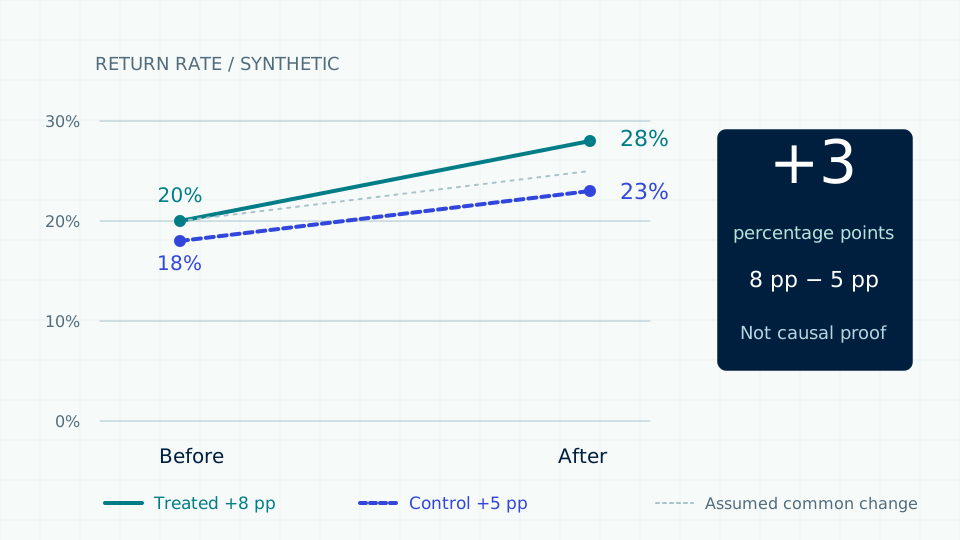
An eight-point gain is not an eight-point effect
Synthetic data: retention moves from 20% to 28% in treatment and 18% to 23% in comparison. Compare changes before assessing identification.
- Arithmetic
- (28−20)−(23−18)=3 percentage points.
- Validation
- Inspect comparability, pre-trends, concurrent campaigns and spillover; the difference alone is not causal proof.
- Settlement
- Also reconcile incremental margin, incentives, returns and the audit window.
What should you do and deliver?
Define reproducible retention
- OUTPUT
- Metric contract + query
- PASS CONDITION
- The same data yields the same denominator
Design attribution and cost checks
- OUTPUT
- Pilot + acceptance sheet
- PASS CONDITION
- Separate change, attribution and settlement
Separate product and outcome service
- OUTPUT
- Modules + risk ownership
- PASS CONDITION
- Each commitment has a controllable action and evidence
How do you prove completion and reuse the work?
Acceptance checks
Submit reproducible ledgers, assumptions, execution logs and omissions. Preserve disputed increments rather than changing baselines after results.
Reusable assets
The commercial contribution is turning outcomes into data, actions and acceptance, not merely promising performance-based pricing.
Further reading and original sources
- 从卖工具到卖效果:RaaS 如何重塑 ToB 市场格局? ↗神策数据 / Sensors Data · 2025-10-29
- Difference-in-Differences ↗World Bank DIME · 2023-08-07