See the structure, then implement and verify with the notes.
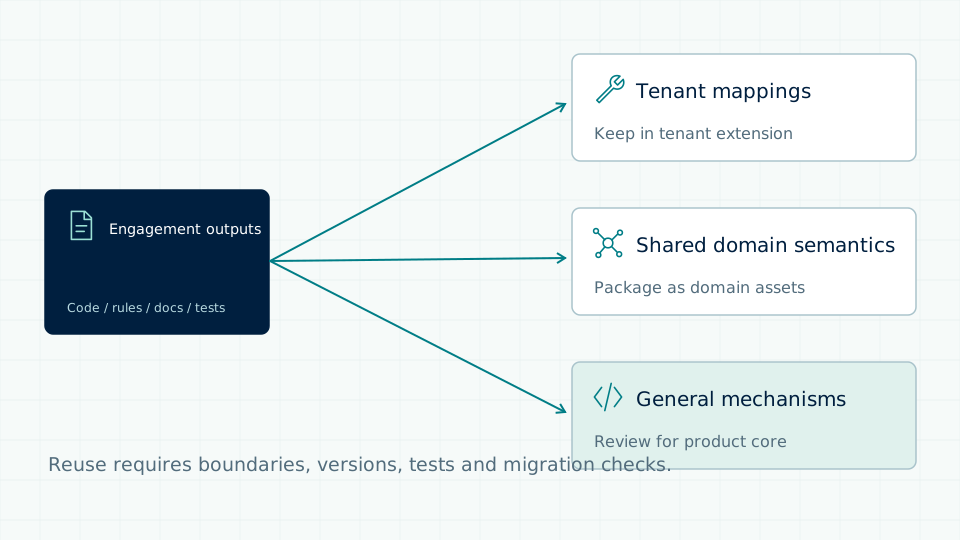
Keep tenant mappings local, package shared domain semantics, and review general mechanisms for the product core.
What situation are you walking into?
The pilot ends. The customer asks what is next; product asks what belongs in the core. Separate customer-specific knowledge, industry methods and genuinely reusable capabilities.
01 / A retrospective that preserves evidence
Revisit goals, reconcile results, analyze causes, extract mechanisms and assign next actions. Link each claim to decisions or failure examples. Replace “poor communication” with the missing role, information and checkpoint. Examine system conditions, not just individual blame.
02 / Audit six delivery failure patterns
Audit value drift, hidden semantic debt, happy-path demo bias, autonomy ahead of evidence, unowned operations and superficial reuse. For each, name an early warning and a checkpoint that would reveal it before production.
03 / Platform, business agents, FDE and enablement
The base carries access, tool contracts, evaluation and observability; scenario modules carry domain objects, tasks and skills; FDE work adapts and validates in the field; enablement transfers operation to the team. This is a product architecture, not a claim that every layer is already a packaged product.
04 / Test reuse with a second scenario
Moving retention to B2B prospecting may retain tool registration and evaluation infrastructure, but objects become accounts, contacts and opportunities. Permissions and success definitions change. Distinguish direct reuse, adaptation and non-transferable elements with validation effort.
Put the method to work
Reusable: idempotency validation and authorization test patterns. Adaptable: segmentation semantics, evidence freshness and user workflows. Not public: customer records, channel strategy, contracts and private scoring parameters. A reusable connector does not grant rights to customer data.
Practice this week
- Submit a five-step retrospective and six-pattern audit.
- Classify artifacts into customer-specific, industry and core assets.
- Choose a second industry and document transfer conditions and product feedback.
Acceptance checks
- Reuse exposes no customer or third-party secrets.
- Specify non-applicability and transfer prerequisites.
- Product proposals include reproduction, impact and regression evidence.
90 minutes: transfer a method without transferring secrets
Move from retail advice to sales briefing. Objects, privacy and freshness differ; evidence methods, tool contracts and failure analysis may transfer. Practice abstraction plus revalidation, not prompt copying.
0–20 min: classify assets into core, domain/task module, tenant adapter and confidential/non-reusable. Record provenance and rights.
20–55 min: remove tenant fields, identities, thresholds and private strategies from one code unit and template; rerun them on new synthetic data.
55–90 min: create new evaluations for the target job and test negative transfer. Explain one previous lesson that does not apply.
Artifact excerpt · synthetic example
Asset layers
CORE: argument validation, result states, eval runner interface
TASK: sourced account-brief specification, evidence rubric
ADAPTER: field maps, authorized sources, organizational scope
PRIVATE: identities, client lists, internal budgets, private strategies
Transfer: rights review, new data, reevaluation, version record
Instructor review
Renaming a file “generic” does not make it reusable. Inspect hidden defaults, scope, exceptions and example data. Unclear redistribution rights block external release.
An unseen field challenge ↗
What would justify turning one successful client exception into a standard product feature? Test demand across contexts, maintainability, compatibility and counterexamples.
Case studies for this module
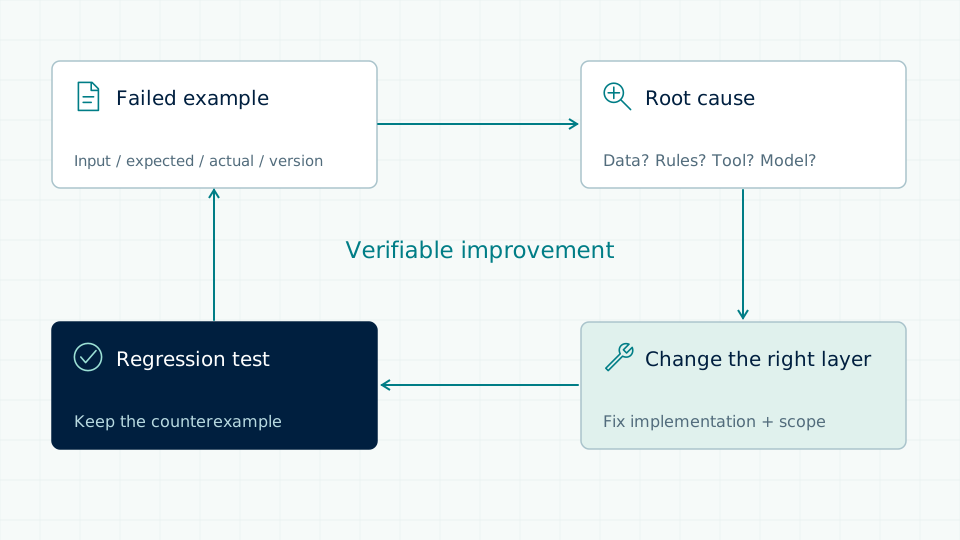
Start with a failed example, locate the cause, change the right layer and add a regression. General intentions cannot prove improvement.
Are renamed customer-A strategy thresholds a public product asset?
Technical portability is not commercial permission. Parameters and strategy may be confidential.
References and further reading
Airbus ↗ · Airbus launches Skywise2017-06-19 · AirbusOpenAI ↗ · OpenAI Deployment Company2026-05-11 · OpenAIRead alongside the assignment and record design constraints and tests. Verify specifications against your deployment version.