See the structure, then implement and verify with the notes.

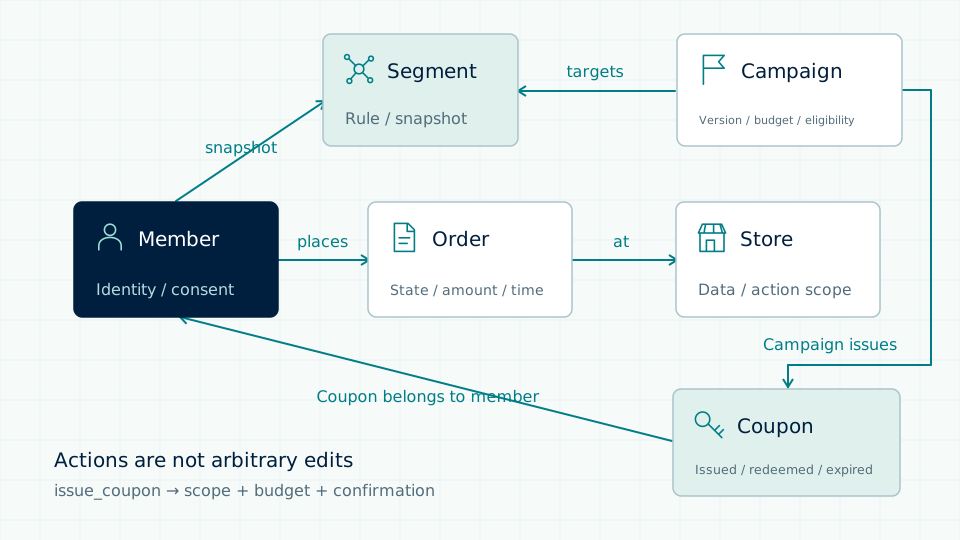
Relationships and lifecycles across members, orders, stores, segments, campaigns and coupons. A teaching model, not a deployed system.
What situation are you walking into?
One customer has two IDs; one metric has three definitions; stores need context-specific answers. A larger model does not automatically repair the business coordinate system.
01 / Entity resolution: examine false merges
Start with stable keys. Fuzzy matching produces candidates, not permission to merge people with similar names or shared phones. Separate auto-merge, review and keep-apart decisions with evidence and lineage. Compare false-merge and missed-match consequences.
02 / Ontology makes data actionable
Objects need stable identity, state and visibility. Links need timing and provenance. Actions need eligibility, limits, idempotency and audit. The ontology identifies what we discuss, metric contracts define calculations and action contracts define authority. Version them independently.
03 / RAG and metrics answer different questions
Use controlled computation for structured metrics and retrieval for manuals and policies. Keep source documents, retrievable chunks, object links and validated Q&A separate. Preserve page, version, product and permission metadata. Cite evidence and abstain or clarify when no applicable source exists.
04 / MCP connects tools; it does not define the task
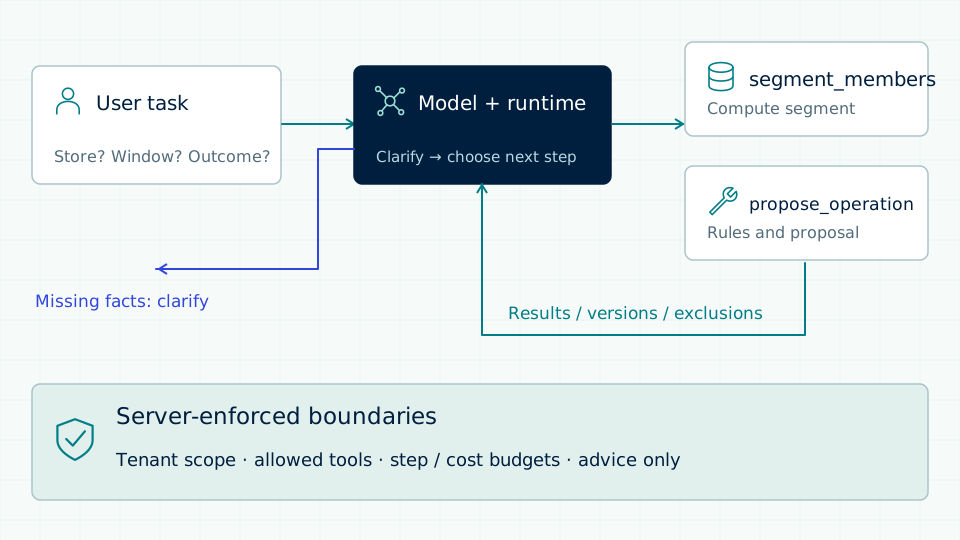
Define host, client and server responsibilities plus tool inputs, outputs, access and errors. A protocol does not grant authorization or business meaning. An advisory agent chooses queries or retrieval from the goal, incorporates results and may clarify before recommending. A fixed API chain is a workflow.
Put the method to work
For “which inactive members should we re-engage?”, clarify the inactivity window, query authorized valid orders, exclude opted-out members and retrieve applicable offer rules. Explain candidates, constraints and hypotheses. These inputs cannot establish that anyone will certainly repurchase.
Practice this week
- Build identity mappings, a review queue and ontology v1.
- Define two read-only tools and a versioned knowledge index.
- Submit three task traces including clarification and insufficient evidence.
Acceptance checks
- Fuzzy matches are not treated as identity facts.
- Conclusions match evidence, permissions and metric versions.
- Model judgment is distinct from deterministic calculation.
120 minutes: separate tools, retrieval and model judgment
Use ontology.json, identity-candidates.csv and the synthetic manuals. Establish object and knowledge constraints before designing a model loop. The trace below is desired behavior, not evidence of an executed model.
0–30 min: label identity pairs as confirmed, review or separate. Describe false-merge harm and express metric scope through Member—Order—Store.
30–75 min: design E03 retrieval tests for AX10 and BX20. Clarify an unknown model, confirm firmware and filter before retrieving, and cite document ID, version and section.
75–120 min: connect a choose(context) model adapter in an authorized environment. Initially expose only read_metric. Submit normal, clarification and insufficient-evidence traces; the scripted planner is not a model benchmark.
Artifact excerpt · synthetic example
Target trace / not an executed model trace
User: What should I do about E03?
Agent: Which model and firmware version?
User: AX10, firmware 2.0.
Retrieval filter: model=AX10, firmware=2.0
Evidence: Manual AX10 / v2 / page 4
Answer: only supported steps, with version citation
Missing evidence: say unknown; do not borrow BX20 instructions
Instructor review
Score retrieval, citation support and omitted constraints separately. Do not collapse all failures into “hallucination.” A tool schema does not replace execution-side authorization.
An unseen field challenge ↗
If the model requests arbitrary SQL, redesign the capability as a bounded business query. Specify allowed parameters, server-enforced scope and rejection conditions.
Case studies for this module
The model clarifies and chooses tools. Deterministic tools provide evidence; the server enforces scope. No coupon issuance at this stage.
Does a working MCP connection authorize all customer data?
Connectivity is technical; authorization is a business and security boundary enforced server-side.
References and further reading
Palantir ↗ · Ontology overview查阅 / Accessed 2026-09-07 · PalantirModel Context Protocol ↗ · MCP architecture overview2026-07-28 · Model Context ProtocolModel Context Protocol ↗ · MCP security best practicesDraft · 查阅 / Accessed 2026-09-07 · Model Context ProtocolOpenAI ↗ · Function calling查阅 / Accessed 2026-09-07 · OpenAIRead alongside the assignment and record design constraints and tests. Verify specifications against your deployment version.